What Is a Survey and What Is the T-47 When You Buy a Home in Texas?
What a survey is, who pays for it under the contract, what the T-47 does, and which contract option can protect the boundaries of your home.

Written by Lliliam Foster, REALTOR® with eXp Realty, LLC, bilingual real estate advisor in Greater Houston.

A survey is the map of your lot that a registered land surveyor prepares, and the T-47 is the sworn statement in which the seller says whether anything on the property changed since that map was made. What protects the boundaries of your home is an option in the title insurance policy that the buyer and the seller mark in the contract before closing.
This is for you if you are buying a home in Texas and want to understand which papers you can receive about the land before you decide. Under the Texas Real Estate Commission (TREC) resale contract in effect in 2026 and the Texas Department of Insurance forms T-47 and T-47.1, this is how it works. Those papers can change, so confirm that you are working with the current version.
- Who pays for the survey depends on the option the buyer and the seller mark in the survey paragraph of the contract.
- The T-47 is a sworn statement that the seller signs in front of a notary. The T-47.1 says the same thing and needs no notary.
- If the boundary exception in the title policy is not changed, the policy leaves out boundary problems and buildings that cross from one lot onto another.
- The title company and the buyer’s lender have to accept the survey you want to use.
What is a survey?
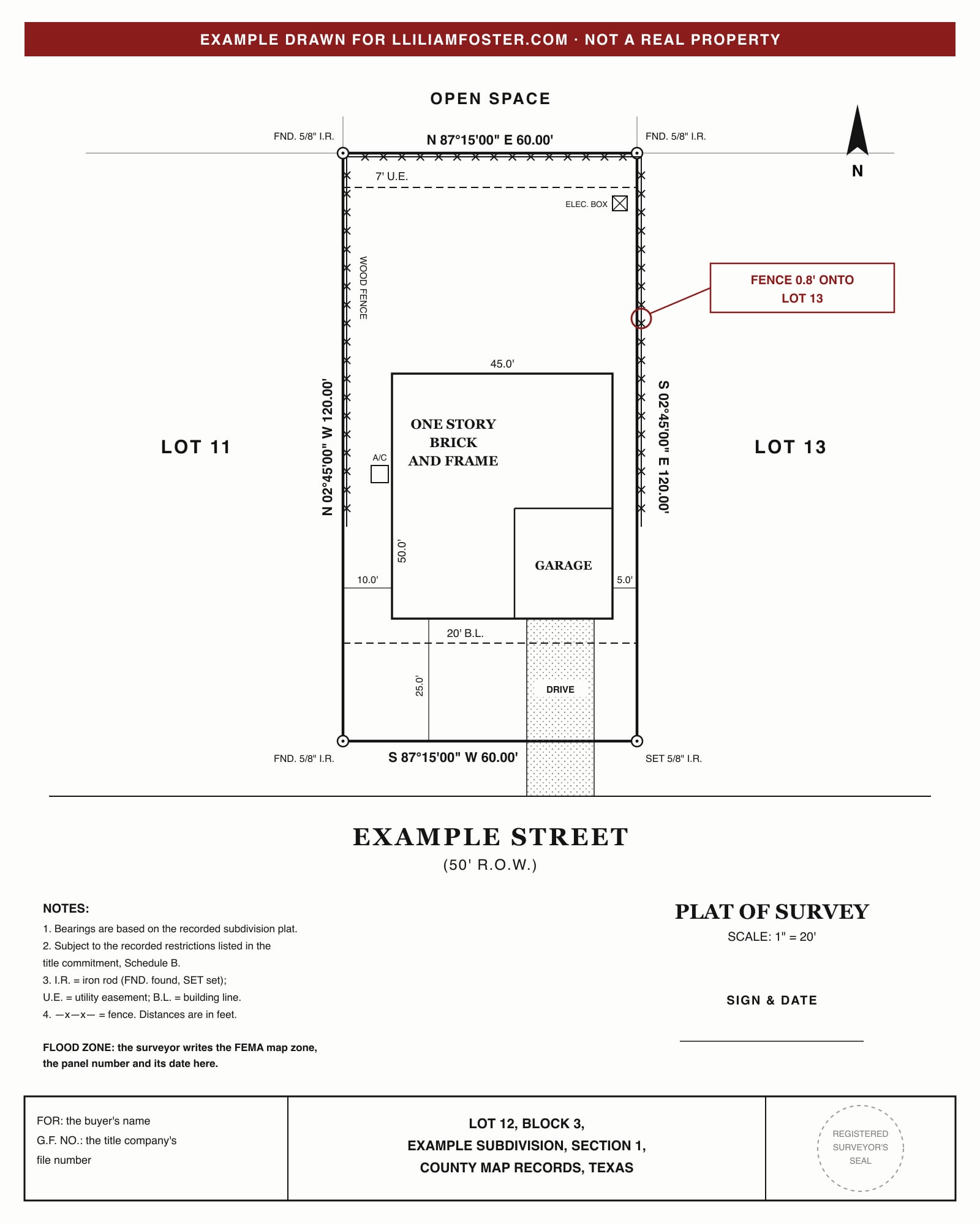
A survey is the map of your lot that a registered professional land surveyor prepares. It shows the boundary lines, what is built on the lot, and the easements, which are rights of way that affect the property. It can also show things you may want to check before closing, such as a fence or a building that appears to cross the boundary line.
The TREC contract asks for a survey made by a registered surveyor that the title company and the buyer’s lender (the bank or company financing the purchase) accept. If the survey shows a title or boundary problem, the buyer may have a deadline to object in writing to the seller. That deadline depends on what the buyer and the seller agreed to in the contract.
Who pays for the survey in Texas?
It depends on the option the buyer and the seller mark in the contract. The survey paragraph has three options, and each one says who gets the survey and who pays for it.
Under the first option, the seller gives the buyer and the title company the survey the seller already has, together with the T-47 or the T-47.1, within the number of days the two sides agreed on, counted from the effective date of the contract, which is the day the last person to sign, the buyer or the seller, tells the other that they have signed. If the seller does not deliver them on time, the buyer orders a new survey and the seller pays for it. And if the seller does deliver them but the title company or the lender does not accept the survey or the T-47 or T-47.1, the buyer orders a new one from the surveyor, and the seller or the buyer pays for it, depending on what the two of them marked in the contract.
Under the second option, the buyer orders and pays for a new survey, and under the third, the seller pays for a new survey and gives it to the buyer.
What is the T-47 and why does it matter?
The T-47 is a sworn statement (an affidavit) on a Texas Department of Insurance form. In it, the seller says whether anything on the property changed since the date of the survey. The form asks, among other things:
- Whether anything new was built, such as a room, a garage, a pool, or a deck.
- Whether a fence or a wall moved.
- Whether a neighbor built on the boundary line or near it.
- Whether there was a conveyance, a change to the subdivision plat (a replat), or a new easement.
With this statement, the title company can rely on a survey that already exists to give the area and boundary coverage that the buyer or the lender asked for. The form also says that the seller is responsible to the title company only for what the seller knew was incorrect and did not say.
The T-47.1 asks the same questions and is not signed in front of a notary. The person who signs it writes their name, date of birth, and address, and declares under penalty of perjury that what it says is true. It has been in effect since November 1, 2024.
What protects the boundaries if the survey has an error?
The survey shows where the boundaries are, but the document that can cover certain boundary problems, such as a fence or a building that crosses onto a neighbor’s lot, is the buyer’s owner’s title insurance policy. The policy comes with an exception for discrepancies, conflicts, and shortages in area or boundary lines, and for buildings that cross from one lot onto another.
The contract has one option that leaves that exception as it is and another that changes it. When it is changed, the exception can be limited to “shortages in area.” With that change, the policy may cover boundary problems and buildings that cross from one lot onto another, except what the title company excludes based on what the survey shows. The buyer or the seller pays for the change, depending on the box they mark in the contract.
The title company has to accept the survey to give that coverage. Under the Texas title insurance rule in effect in 2026, the company can accept a survey that already existed, even one prepared for a different owner, when it comes with the T-47. For a residential policy, that same rule sets the cost of this coverage at 5% of the basic rate of the policy.
Can you use the previous owner’s survey?
It is possible, but the title company and the buyer’s lender have to accept it. The contract option in which the seller gives you the survey the seller already has is the one that allows it. The contract sets no maximum age for the survey, but each title company decides which survey it accepts. If the property has changes that do not appear on the survey, such as a new fence, the title company may ask for an updated one.
From real life
Recently, with one of my buyers, the other agent would not have the seller sign the T-47 in front of a notary before my buyer and the seller signed the contract. Without that paper, my buyer could not know whether the survey still showed the property as it is or whether something had changed since it was made. They had to decide with incomplete information.
In my opinion, you should ask for the T-47 or the T-47.1 before you sign, when that is possible. It can help you see whether the survey you are being given still describes the property.
In another case, this happened to a client of a friend of mine who is also a Realtor. They bought a home and closed without any problem. About two years later, when they decided to sell it, the neighbor told them the fence was out of place. When they looked into it, the neighbor was right. The survey they had used to buy had an error at the boundary. They had to move the fence and lost a strip of land that ran across the width of the house. They started to prepare a claim, but after talking with the title company that had handled the purchase, they did not file it.
Because I love learning from other people’s experiences, that story made me dig deeper into this topic. In my opinion, before closing it makes sense to ask which option was marked in the contract about the boundary exception in the title policy.
What would I check before deciding?
I would follow this order:
1. Ask for the survey and the T-47 or T-47.1 before signing, and check the date of the survey.
2. Look at which survey option is marked in the contract and who pays for it.
3. Ask the title company whether it accepts that survey.
4. Decide whether to change the boundary exception in the policy, and who will pay for that change.
Does the T-47 have to be signed in front of a notary?
Yes. The seller signs the T-47 in front of a notary before delivering it. The T-47.1 needs no notary, because the person who signs it declares under penalty of perjury that the information is true. To sign the T-47 in front of a notary, I recommend that the seller use the notary at their bank, because it is easy to get to and it often does not charge its customers.
Who orders the new survey from the surveyor?
When the survey the seller delivers is not accepted, the buyer orders the new one from the surveyor, even if the seller pays for it.
How much does it cost to change the boundary exception in the policy?
For a residential policy, it is 5% of the basic rate of the policy, under the Texas title insurance rule in effect in 2026. The buyer or the seller pays for the change, depending on the box marked in the contract.
Which option to mark is a decision for you and the seller. If you are thinking of buying in north Houston and want to go over these documents with me, you can write to me, and we will go through them calmly.
My work with buyers is explained on my Buy page, and my articles on the option period and earnest money explain what happens in the first days of the contract.
Lliliam Foster is a bilingual REALTOR® with eXp Realty serving Spring, The Woodlands, Conroe, Magnolia, Tomball, Cypress, Humble/Atascocita, North Houston/Aldine and the FM 1960 corridor. Information current as of October 2026.
Lliliam Foster, REALTOR® — eXp Realty. This information is general in nature and does not constitute legal or financial advice. eXp Realty, LLC is a real estate brokerage licensed in Texas.